
C1A Form
Key Takeaways
- Form C1A is a supplemental family court form used to detail allegations of harm or domestic violence in proceedings about children and adults.
- You cannot use a C1A to start a court case on its own — it must be submitted with a primary application, such as a C100 (child arrangements) or other relevant court form.
- The C1A helps the court assess safety and risk by setting out factual information about abuse, violence, or risk of harm.
- Both applicants and respondents may complete a C1A when allegations or concerns arise.
- Detailed, fact-based entries with dates, locations, and context are critical to helping the court make decisions about welfare and protection.
What Is a C1A Form?
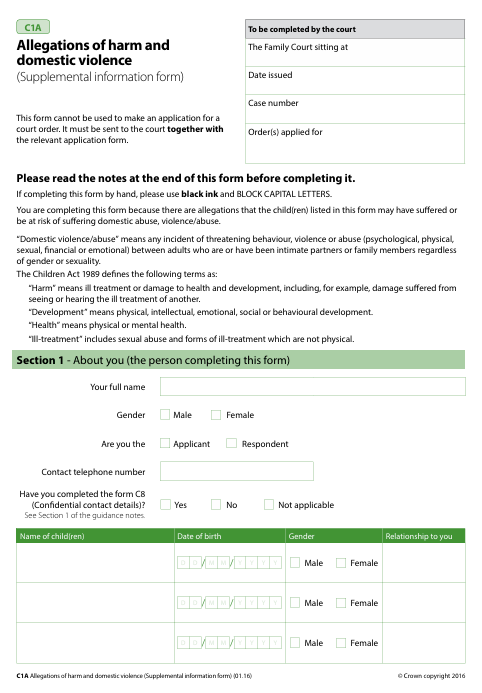
Form C1A is a supplemental information form used within family court proceedings in England and Wales. It is designed to inform the court about allegations of harm or domestic violence affecting a child or adult in the case.
Unlike the C100 — which asks the court for specific orders — the C1A does not itself request a court order; instead, it provides important contextual details that support or respond to allegations made in the main application.
Why Does the Court Use the C1A Form?
Family court proceedings focus strongly on safeguarding. When there are concerns about a child’s safety or welfare, the court must have clear, factual information early in the process to make informed decisions about protective measures. The C1A helps with this by:
- Detailing specific instances of harm or risk of harm.
- Giving the court factual context around domestic abuse, violence, or emotional harm.
- Allowing the respondent to address or dispute allegations made by the applicant.
- Supporting assessments by CAFCASS officers and judges about child welfare.
When Do You Use a C1A Form?
You should complete a C1A when:
1. Making Allegations
You are the applicant in a family court case (for example using a C100), and you need to explain:
- Instances of domestic violence or abuse.
- Harm suffered by you or the child(ren).
- The risk of future harm, including psychological or emotional injury.
2. Responding to Allegations
You are the respondent to a C100 or other application and the other party has made allegations of harm — you can use C1A to provide your factual response.
3. Providing Court With Context
Any time the court needs fuller background on allegations of abuse or risk in a case involving children, the C1A gives a structured way to present that information.
How to Complete the C1A Form
The C1A form asks you to provide clear, factual information. Key sections typically include:
Your Details
- Your full name and role — applicant or respondent.
- Contact information (use of confidential contact details may be appropriate in safety concerns).
Information About the Children
- Names and birth dates of child(ren) affected.
- Your relationship to each child.
Allegations Section
You must provide factual descriptions of:
- What happened (clear description of behaviours or incidents).
- When and where it happened (dates and places).
- Who was involved or present.
- Impact on you or the children.
This should be objective and evidence-oriented — for example, including reference numbers from police reports, medical evidence, or witness accounts where possible.
Link to Proceedings
The form also asks which order(s) you are seeking or responding to, so the court can connect the allegations to the main application.
Important Rules About Using the C1A
Cannot Be Used Alone
- A C1A cannot start a legal case — it must be attached to, or submitted alongside, another application such as a C100 or C1.
Supplement to Main Forms
- If you’re filing C1A with a C100 online, the supplemental sections are usually integrated into the digital application.
Responding Parties May Use It Too
- If the other side makes allegations in their application, you can complete a C1A to respond factually rather than ignoring the assertion.
Practical Tips
- Be factual and detailed — judges rely on facts, dates, and context, not emotion.
- Include supporting evidence (police reports, medical records, witness statements) where possible.
- Use a separate witness statement if you need to provide additional context not suited for the structured C1A format.
- Check confidentiality options on contact details if safety is at risk.
Common Questions About C1A
Do judges see what I write on C1A?
Yes — the information submitted via C1A is part of the court record and used by judges and CAFCASS officers in their assessments.
Can the respondent use it?
Yes — both applicants and respondents can submit C1A when there are allegations or responses to allegations in a case.
Does it replace a witness statement?
No. A C1A is a supplemental form; you may still need a witness statement for additional context or detail.
Is this about domestic violence only?
No — it covers harm and risk of harm, which includes domestic violence, abuse, emotional harm, risk of abduction, or other threats to welfare.
Conclusion
The C1A form is a vital part of family court processes in England and Wales when harm, domestic violence, or risk to children or adults are issues in a case. While it doesn’t start a court case, it ensures the court has structured, factual information to safeguard welfare and make informed decisions. Completing it clearly, accurately, and with supporting evidence helps protect safety and strengthens the court’s ability to respond appropriately.