
C79 Form
Key Takeaways
- The C79 form is used in family court proceedings to enforce a child arrangements order when one parent or party is not complying with it.
- You can only use a C79 after a child arrangements order has already been made by the court.
- The form asks the court to consider enforcement action, not to re-decide arrangements from scratch.
- The court’s focus is on why the order was breached and whether there was a reasonable excuse.
- Possible outcomes include enforcement orders, unpaid work requirements, compensation, or changes to arrangements.
What Is a C79 Form?
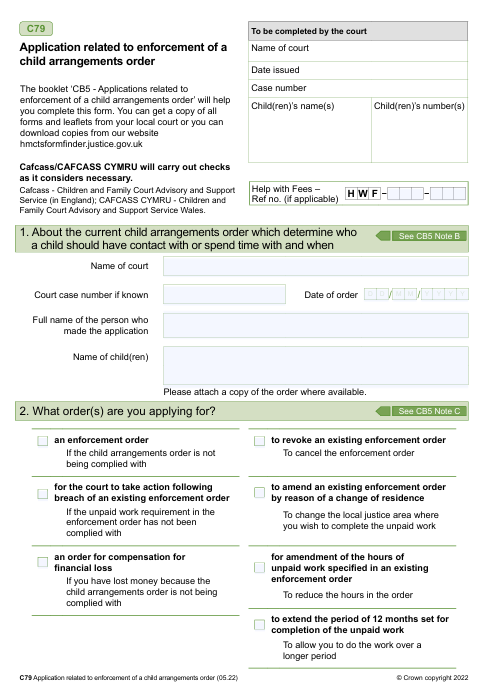
The C79 form is a family court application used in England and Wales to ask the court to take action when a child arrangements order is not being followed.
It is specifically designed to deal with breaches of existing court orders — most commonly where:
- A parent is refusing contact
- A child is not being made available as ordered
- Agreed time, handovers, or schedules are repeatedly ignored
In short:
C100 asks the court to make an order.
C79 asks the court to enforce an order that already exists.
When Do You Use a C79 Form?
You use a C79 after the court has made a child arrangements order and one party has failed to comply with it.
Common situations include:
- A parent repeatedly cancelling contact without justification
- A child not being returned on time
- Refusal to follow holiday or overnight arrangements
- Ignoring handover locations or times
- Breaching indirect contact arrangements (calls, video contact, messages)
The C79 is not used to change arrangements — only to address non-compliance.
Can a C79 Form Start a Court Case?
No. A C79 cannot start proceedings.
There must already be:
- A valid child arrangements order, and
- An existing or concluded family court case relating to that order
If no order exists yet, the correct form is usually a C100, not a C79.
Who Can Apply Using a C79 Form?
- The parent or party in whose favour the order was made
- Any person named in the child arrangements order
You must be able to show:
- What the order says
- How it has been breached
- When and how often the breach occurred
What Does the Court Look At?
The court does not automatically punish breaches.
Instead, it considers:
- Whether the order was clear and understood
- Whether the breach actually occurred
- Whether the person in breach had a reasonable excuse
- Whether enforcement is in the child’s best interests
The child’s welfare remains the court’s paramount concern.
What Is a “Reasonable Excuse”?
A reasonable excuse may include:
- The child being ill
- Genuine safeguarding concerns
- Circumstances genuinely outside a parent’s control
However, excuses must be:
- Genuine
- Proportionate
- Supported by evidence where possible
Repeated or vague excuses are unlikely to be accepted.
What Can the Court Do After a C79 Application?
If the court finds that a breach occurred without reasonable excuse, it may:
- Make an enforcement order
- Order unpaid work (up to 200 hours)
- Order financial compensation for missed contact (e.g. travel or accommodation costs)
- Vary the child arrangements order
- Make additional directions to improve compliance
- In serious cases, consider fines or committal proceedings
The aim is compliance — not punishment for its own sake.
How to Complete the C79 Form
The C79 form asks for clear, factual information.
Key Sections Explained
Details of the Existing Order
You must include:
- The date of the order
- The court that made it
- Exactly what the order requires
Attaching a copy of the order is strongly recommended.
Details of the Breach
You will need to explain:
- What parts of the order were breached
- Dates and times of non-compliance
- How often the breach has occurred
- Any attempts you made to resolve the issue
Stick to facts — avoid emotional or argumentative language.
What You Want the Court to Do
You can ask the court to:
- Enforce the existing order
- Consider sanctions
- Give directions to prevent further breaches
Be realistic and child-focused in what you request.
Do You Need Evidence?
Yes — evidence strengthens a C79 application.
Helpful evidence may include:
- Text messages or emails
- Travel receipts
- Missed contact logs
- Previous warning letters
- School or third-party confirmations
You don’t need perfect evidence, but you do need credible detail.
What Happens After You File a C79?
- The court issues the application
- The other party is served and can respond
- A hearing is listed
- The court considers evidence and explanations
- A decision is made on enforcement
CAFCASS may be involved if the breach raises welfare or safeguarding concerns.
Is There a Fee for a C79 Form?
Yes — a court fee usually applies.
If you are on a low income or receive certain benefits, you can apply for Help With Fees using form EX160.
Can the Court Refuse a C79 Application?
Yes. A C79 may be refused or dismissed if:
- The breach is minor or isolated
- There is a reasonable excuse
- Enforcement would not benefit the child
- The issue is better dealt with by varying the order instead
In some cases, the court may suggest mediation or a different application route.
Common Questions About the C79 Form
Can I use a C79 to change contact arrangements?
No. To change arrangements, you usually need a C100, not a C79.
What if the other parent keeps breaching the order?
Repeated breaches strengthen enforcement applications and may lead to stronger sanctions.
Do I need a solicitor?
No. Many people complete and submit a C79 themselves, or use specialist services like FamilyLawForms to help prepare the form without the cost of a solicitor.
Will the court punish the other parent?
The court’s goal is compliance and the child’s welfare, not punishment — but sanctions are available if needed.
Practical Tips for Using the C79 Form
- Keep a clear record of breaches
- Focus on patterns, not one-off issues
- Remain child-focused in all wording
- Attach the original court order
- Avoid using C79 as a way to re-argue the case
Conclusion
The C79 form is the correct legal route when a child arrangements order is being ignored or breached. It allows the court to step in, assess what has gone wrong, and take action to restore compliance — always with the child’s best interests at the centre.
Used properly, a C79 can be a powerful tool to ensure court orders are respected and children maintain consistent, meaningful relationships as intended.