
C120 Form
Key Takeaways
- The C120 form is a government witness statement template specifically for child arrangements – parental dispute cases in England and Wales.
- You usually file C120 alongside a main application (like a C100 or C2) so the court has your version of the facts.
- It is structured evidence — not just a narrative — but your written statement to the judge about the issues the court must decide.
- Both parties’ C120 statements will normally be disclosed to the other side as part of the proceedings.
- You do not have to use C120 in every case; if the court or judge requires something else (e.g., more detailed statements), you must follow their direction.
What Is a C120 Form?
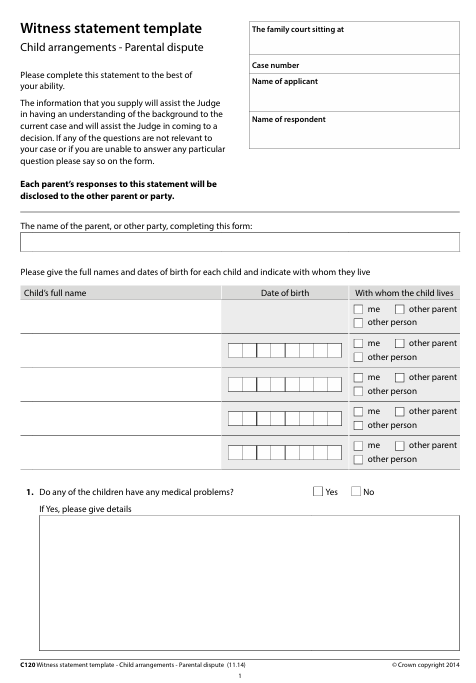
The C120 is the official witness statement template published by HM Courts & Tribunals Service for parental disputes about child arrangements.
Rather than being an “application” itself, it’s a standard form for parties to set out their evidence in a structured way so the judge understands:
- the background to the dispute,
- each party’s position, and
- the facts the court should consider when making decisions.
It’s widely used when proceedings concern:
- child arrangements orders
- specific issue orders
- prohibited steps orders
and is typically submitted alongside those forms.
Why the C120 Matters
In family law proceedings, the court needs clear, relevant, factual evidence before making decisions about children. A witness statement:
- sets out your position and evidence,
- explains your proposals to the court, and
- helps the judge decide what is in the best interests of the child.
The C120 form helps you structure that evidence in a way the court expects, ensuring you provide all relevant information about:
- the children,
- living arrangements,
- parenting history, and
- what you are asking the court to decide.
When Do You Use C120?
You normally use C120 when:
- You’ve started proceedings or are about to (most commonly with a C100 child arrangements application).
- You are responding to an existing case and need to provide your evidence.
- The court directs you to file a statement of evidence.
You don’t use C120 to start a case on its own — you must attach it to the appropriate application (e.g., C100 or C2).
How the C120 Works
The form is structured like a witness statement, and includes sections for you to provide:
1. Case and Party Details
- Court name and case number (if known)
- Your name and the respondent’s name
These identify whose evidence the court is reading.
2. Child Details
- Full names and dates of birth of the children
- Indication of who they live with
This gives the judge immediate context about the family.
3. Background Questions
C120 contains guided questions about:
- living arrangements prior to court
- separation details
- childcare arrangements
- distance between homes
- children’s schooling and activities
- parenting routines and proposals
- any concerns you have about the other parent
These questions help the judge see the practical reality, not just assertions.
4. Your Proposals
The form asks you to state:
- what arrangements you think the court should make, and
- your reasons why those arrangements are best for the children.
5. Statement of Truth
At the end you sign a statement of truth, confirming the facts you have given are correct to the best of your knowledge.
Is C120 a Witness Statement?
Yes — C120 is a witness statement template. It’s designed so that what you write in it is your written evidence to the court.
Unlike a separate narrative statement you might draft yourself, C120:
- contains specific question prompts, and
- ensures all key topics the judge usually needs are covered.
You can use a separate statement if:
- the court specifically directs you to do so, or
- you need more space or additional evidence beyond what fits in the C120 sections.
Filing and Disclosure
Once completed:
- You file the C120 with the court at the same time as your main application (C100 or C2).
- Copies are served on the other parent/party and usually provided to CAFCASS (Children and Family Court Advisory and Support Service).
- Each party’s responses are disclosed to the other as part of the evidence exchange.
This transparency helps ensure both sides and the judge have all relevant facts early.
Practical Tips for Completing C120
✔ Be factual and specific — stick to what you know and can support with evidence.
✔ Answer the questions directly — don’t skip sections unless truly irrelevant; note “not applicable” if you skip.
✔ Attach evidence where necessary — for example education or medical records, schedules, or correspondence.
✔ Focus on the child’s welfare — the judge’s decision centres on what’s best for the children.
✔ Keep copies for yourself, the court, and the other party.
Common Questions About C120
Do I need a solicitor to use C120?
No — it’s designed for self‑represented parties (litigants in person) as standard evidence in court.
Is there a fee for C120?
No separate fee for the C120 itself — any fee applies to the main application form (e.g., C100).
Can I use C120 if I’m responding to allegations?
Yes — you use C120 to provide your account of facts and respond to the other party’s evidence.
What if I need more space?
You can attach additional sheets clearly labelled with your name, case number, and question number.
Conclusion
The C120 form is not just an optional add‑on — it is the government’s witness statement template for child arrangements disputes. It provides a structured, question‑led way for parties to present their evidence to the family court and is normally used in conjunction with a C100 or C2 application.
Filling it out clearly, with relevant supporting evidence, helps the court understand the real issues and make informed decisions in your case.