
Position Statement
Key Takeaways
- A Position Statement is a short written document explaining your current position, key issues, and what orders you are asking the court to make at a hearing.
- It is not evidence and not a witness statement, but a practical summary to help the judge understand the case quickly.
- Position Statements are most commonly used before hearings such as FHDRA, directions hearings, reviews, and final hearings.
- They are especially important for litigants in person, as they keep hearings focused and prevent key points being missed.
- Courts usually expect Position Statements to be concise (2–4 pages) and served shortly before the hearing.
What Is a Position Statement?
A Position Statement is a document used in the Family Court of England and Wales to set out:
- where the case currently stands,
- what the main areas of agreement and dispute are, and
- what decisions you want the court to make at the upcoming hearing.
It acts as a snapshot of your position at that specific point in time, rather than a full history of the case.
Judges often read Position Statements immediately before the hearing, sometimes for the first time that day, so clarity and structure matter.
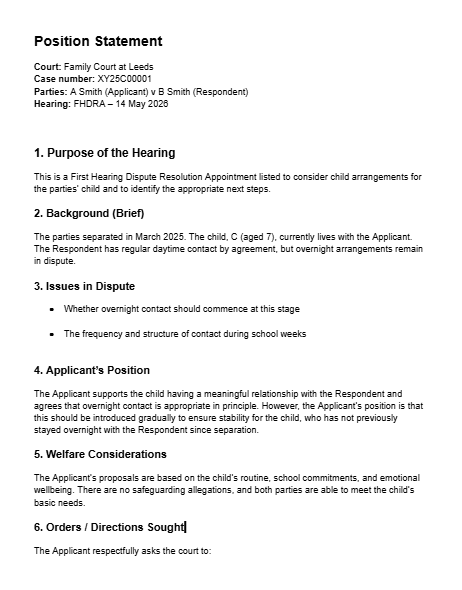
Is a Position Statement the Same as a Witness Statement?
No — they serve very different purposes.
| Document | Purpose |
|---|---|
| Witness Statement | Sets out evidence of facts, signed with a statement of truth |
| Position Statement | Summarises issues, proposals, and what you want the court to do |
| Application (e.g. C100, C2) | Asks the court to start or vary proceedings |
A Position Statement:
- should not repeat long factual narratives already filed.
- does not usually include a statement of truth,
- should not introduce new evidence, and
- should not repeat long factual narratives already filed.
DWhen Is a Position Statement Used?
Position Statements are commonly filed before:
- First Hearing Dispute Resolution Appointment (FHDRA)
- Directions hearings
- Review hearings
- Interim hearings
- Final hearings
They may be:
- requested by the court, or
- expected as good practice, even if not formally ordered.
In some courts, judges now expect Position Statements as standard.
Who Needs to File a Position Statement?
Both applicants, and respondents can (and usually should) file Position Statements.
They are particularly important if:
- you are representing yourself,
- the case has multiple applications,
- there are safeguarding or welfare concerns, or
- you want the court to make specific directions or orders.
What Should a Position Statement Include?
While there’s no single mandatory format, a strong Position Statement usually includes the following sections.
1. Case Details
At the top:
- Court name
- Case number
- Names of the parties
- Hearing date and type
This helps the judge immediately place the document in context.
2. Purpose of the Hearing
Briefly explain:
- what the hearing is for, and
- what decisions the court is expected to make.
Example:
“This is an FHDRA listed to consider child arrangements and safeguarding concerns.”
3. Background (Very Brief)
A short summary of:
- who the child(ren) are,
- current living arrangements, and
- how the case reached this stage.
This should be high-level only, not a detailed history.
4. Issues in Dispute
Set out clearly:
- what is agreed, and
- what is not agreed.
Judges appreciate bullet points here.
Example:
- Agreed: child attends school locally
- Disputed: overnight contact arrangements
5. Your Current Position
Explain:
- what arrangements or outcomes you believe are best, and
- why, focusing on the child’s welfare.
This is where you explain your reasoning, not evidence.
6. Safeguarding or Welfare Concerns (If Any)
If relevant, summarise:
- safeguarding issues,
- risks, or
- concerns already raised elsewhere (e.g. in a C1A).
Do not restate allegations in detail — signpost instead.
7. What Orders or Directions You Are Asking the Court to Make
This is the most important section.
Be specific:
- interim contact arrangements
- directions for CAFCASS
- filing of statements or reports
- timetables
Judges often turn straight to this section.
8. Conclusion
A short closing paragraph confirming:
- your willingness to engage constructively, and
- that your proposals are focused on the child’s best interests.
How Long Should a Position Statement Be?
Typical expectations:
- 2–4 pages
- Rarely more than 5 pages, even in complex cases
If it’s too long, it won’t be read properly.
When and How Do You File It?
Unless the court orders otherwise:
- File and serve 1–3 days before the hearing
- Send to:
- the court,
- the other party (or their solicitor), and
- CAFCASS (if involved)
Some courts allow Position Statements to be handed up on the day, but earlier is always better.
Is There a Court Fee?
No — Position Statements are free to file.
Can You Introduce New Evidence in a Position Statement?
No. A Position Statement should:
- refer to existing evidence,
- not attach new exhibits, and
- not ambush the other party.
If new evidence is essential, you should ask the court for permission to file it separately.
Common Mistakes to Avoid
- Repeating your entire witness statement
- Using emotional or inflammatory language
- Making allegations without evidence
- Being vague about what you want the court to do
- Ignoring previous court orders or directions
Do You Need a Solicitor to Prepare One?
No, but expert legal advice can be helpful. Position Statements are:
- commonly prepared by litigants in person, and
- designed to be practical and accessible.
Many people prepare them themselves or use fixed-fee legal support rather than instructing a solicitor for the whole case.
How Judges Use Position Statements
Judges rely on them to:
- understand the case quickly,
- identify the real issues, and
- manage court time effectively.
A clear Position Statement can shape the direction of the hearing.
Conclusion
A Position Statement is one of the most powerful — and underused — documents in family court proceedings. It gives the judge a clear, focused understanding of your position and allows hearings to concentrate on what actually matters.
Done well, it can save time, reduce conflict, and significantly improve how your case is heard.