
C100 Form
Key Takeaways
- The C100 form is the main application used to ask a family court in England & Wales for orders about a child’s arrangements.
- You generally must attend a Mediation Information Assessment Meeting (MIAM) before applying, unless exempted.
- Common orders include child arrangements, specific issue, and prohibited steps orders.
- You can apply online or by post to your local family court.
- The court will usually schedule an initial hearing after acceptance (First Hearing Dispute Resolution Appointment).
- You may be eligible for help with court fees.
- Completing the form carefully (and including all required evidence/MIAM certificate) reduces the risk of rejection.
What Is the C100 Form?
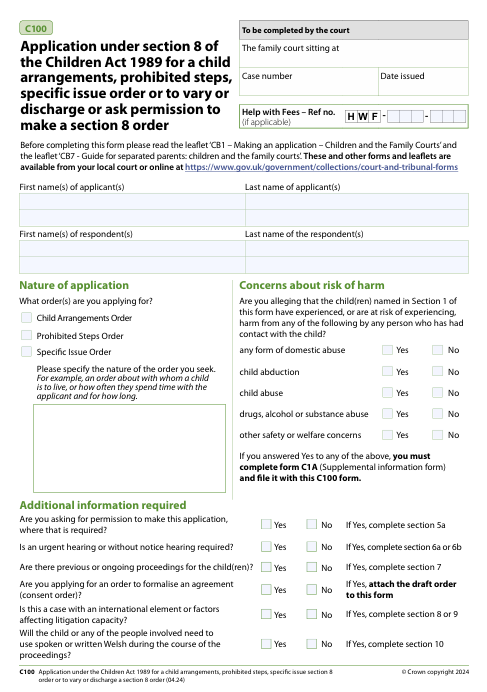
The C100 is the official family court application form used when you are asking for a court order under Section 8 of the Children Act 1989 in England & Wales.
It’s used to apply for:
- Child Arrangements Orders – who a child lives with, spends time with, or has contact with.
- Specific Issue Orders – to resolve a particular issue, e.g., which school a child should attend.
- Prohibited Steps Orders – to prevent someone from doing something without the court’s permission, e.g., taking a child abroad.
Without this form (or the correct alternative), the court cannot consider your application for these types of orders.
Who Can Apply?
Anyone with parental responsibility can apply — such as biological parents, adoptive parents, or those with a parental responsibility order.
Even if your name isn’t on the birth certificate, you may apply if you can show you have parental responsibility or have cared for the child for at least three years (in some cases).
Do You Have to Attend Mediation First? (MIAM)
Yes. Before submitting a C100, you normally must attend a Mediation Information Assessment Meeting (MIAM) to explore whether you can resolve your dispute without going to court.
There are exemptions to this requirement (e.g., family violence, urgency), and you must provide evidence if claiming exemption.
Tip: Courts can return or delay your application if the MIAM requirement isn’t met or evidenced properly.
How to Get and Complete the C100 Form
You can:
- Apply online via the justice service, or
- Download and print the C100 form from gov.uk and complete it manually.
Key Sections in the Form
- Child details: Names, dates of birth, current living arrangements, and contact details.
- Attendance at MIAM: Confirm you’ve attended a MIAM or are exempt.
- Type of order: Tick the relevant box for the order(s) you are asking for.
- Grounds for application: Explain why you want the court to make the order. Use clear, factual language tied to the child’s best interests.
- Permission / urgency: If you need an urgent hearing or permission to apply in relation to other proceedings.
Include supporting documents like MIAM certificates, previous agreements or court orders, and any evidence justifying your application.
How Much Does It Cost?
Applying with a C100 usually involves a court fee (around £263 at recent rates, subject to change).
If you’re on a low income or certain benefits, you may apply for help with fees or a fee exemption with form EX160.
After You Submit the Form
Once accepted by the court:
- The court will serve the form and hearing details to the other party(ies).
- A First Hearing Dispute Resolution Appointment (FHDRA) is usually scheduled — around 4–6 weeks after submission.
- At the FHDRA, the court will try to help the parties reach an agreement. If not resolved, the case will proceed to further hearings.
- Cafcass (Children and Family Court Advisory and Support Service) may be involved and provide recommendations to the court.
Can the Court Reject a C100 Form?
Yes. Common reasons include:
- Missing MIAM evidence
- Not completing required sections
- Using an outdated form
If rejected, the court will normally return it with a note explaining why. You can correct and resubmit without paying another fee if rejected on administrative grounds.
Common FAQs
1. Can I do this without a lawyer?
Yes — that’s where we come in, helping you fill out your C100 form correctly while saving you thousands of pounds on solicitor’s fees.
2. What if the other parent disagrees?
They can file a response and attend hearings. The court will make decisions based on the child’s welfare.
3. What if circumstances change later?
You can apply to vary or discharge a child arrangements order, but that may use a different form or part of the C100 process.
4. How important is the child’s best interest?
It is paramount — the court’s decision will focus on the best interests of the child in every case.
5. What if this is urgent?
You can request an urgent or “without notice” hearing on the form if there are immediate safety concerns.
Conclusion
The C100 form is a central legal document for anyone seeking the court’s help to decide child arrangements or resolve disputes about a child’s upbringing in England & Wales. It’s important to understand its purpose, requirements, and the process that follows submission.
Completing the C100 carefully, attending mediation, and providing all required evidence can make the difference between a smooth application and delays. Always focus on the child’s safety and welfare, as that is what the court prioritises.