
C2 Form
Key Takeaways
- The C2 form is used in family court proceedings to ask the court for permission, directions, or urgent interim orders relating to a child.
- It is not used to start a case — it is made within existing proceedings (most commonly alongside or after a C100).
- The C2 is often used for urgent applications, such as stopping a child being removed, changing interim arrangements, or asking the court to allow another application.
- Both applicants and respondents can use the C2 form.
- The court may deal with a C2 without a hearing, at a short hearing, or urgently (including same-day decisions in serious cases).
What Is a C2 Form?
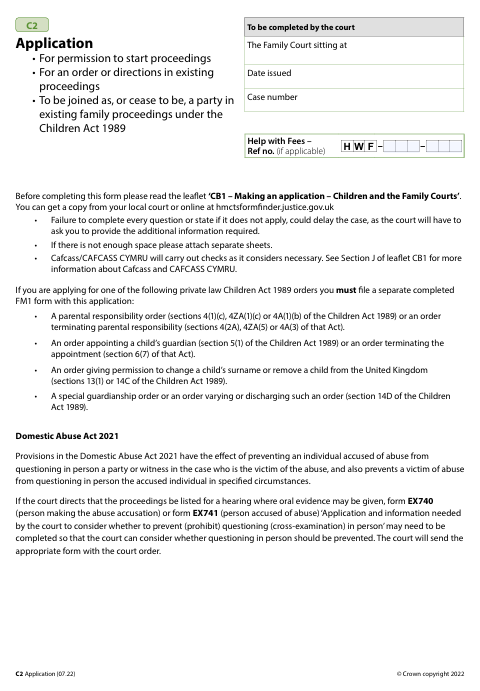
The C2 form is a family court application used in England and Wales to ask the court to make a procedural or interim decision in a case involving children.
Unlike the C100, which asks the court to decide long-term arrangements, the C2 is about permissions, directions, or immediate action within an ongoing case
What Is the C2 Form Used For?
The C2 is very flexible and is used in many situations, including to ask the court to:
- Make an urgent or interim order
- Give permission to make another application
- Change or suspend interim child arrangements
- Add or remove a party to proceedings
- Give directions (for example, about evidence or contact)
- Make decisions relating to parental responsibility
- Approve steps relating to the child’s welfare
- Deal with procedural issues not covered by another form
It is commonly described as a “general application” form for children cases.
When Do You Use a C2 Form?
You use a C2 only when a case is already open.
Typical scenarios include:
Urgent Situations
- A child is at risk of being removed from your care
- A parent is threatening to take a child abroad
- Immediate safeguarding concerns arise
- Interim contact arrangements need to change quickly
Permission Applications
Some applications cannot be made automatically and require the court’s permission first — the C2 is how you ask for that permission.
Procedural Issues
- Asking the court to vary directions
- Asking for an additional hearing
- Requesting changes to interim orders
- Asking for disclosure of documents
Can a C2 Form Start a Court Case?
No. A C2 cannot start proceedings on its own.
There must already be:
- An existing child arrangements case, or
- Another active family court application involving the child
Most commonly, the original application is a C100, and the C2 is used later when something changes or becomes urgent.
Who Can Apply Using a C2 Form?
- The applicant in the case
- The respondent
- Any party already named in the proceedings
In some situations, a person who is not yet a party may apply using a C2 to ask the court for permission to be joined to the case.
How to Complete the C2 Form
The C2 form is shorter than a C100, but it’s important to be clear and specific.
Key Sections Explained
Your Details
- Your name and role in the proceedings
- Confirmation of which case the application relates to
What Are You Asking the Court to Do?
This is the most important section.
You must clearly state:
- What order or permission you are asking for
- Why it is necessary
- Whether the request is urgent
Avoid vague wording. The court should be able to understand your request in one read.
Urgency and Without Notice Applications
You can ask the court to deal with the application:
- Urgently, or
- Without notice to the other party (used only where notifying them could create risk)
You must explain why urgency or lack of notice is justified.
Supporting Information
You may:
- Attach a short witness statement
- Refer to existing evidence in the case
- Attach documents if relevant
Do You Need Evidence With a C2?
Often, yes.
Depending on what you’re asking for, evidence may include:
- Police incident references
- Medical letters
- School or safeguarding concerns
- Previous court orders
- Written threats or communications
The court expects the application to be fact-based, especially for urgent requests.
How Is a C2 Application Dealt With?
Once filed, the court may:
- Decide it on paper (no hearing)
- List a short hearing
- List an urgent or same-day hearing
- Ask the other party to file a response
The court has wide discretion and will choose the approach based on:
- Urgency
- Risk
- Impact on the child
- Fairness to all parties
Is There a Fee for a C2 Form?
There is usually a court fee, although the amount can vary depending on the type of application.
If you are on a low income or receive certain benefits, you may apply for Help With Fees using form EX160.
Can the Court Refuse a C2 Application?
Yes.
The court may:
- Refuse the application outright
- Ask for more information
- Decide the issue at the next listed hearing instead
Common reasons for refusal include:
- The issue not being urgent
- Insufficient evidence
- The request being better dealt with another way
Common Questions About the C2 Form
Is the C2 the same as a C100?
No. The C100 starts a case; the C2 manages or intervenes within an existing case.
Can I use a C2 for emergency child protection?
Yes. Many emergency or interim applications relating to children are made using a C2.
Can the other party oppose a C2 application?
Yes. They may file a response or raise objections at a hearing.
Do I need a solicitor to file a C2?
No. Many people complete and submit a C2 themselves, or use specialist services such as FamilyLawForms to help prepare the form, avoiding the high costs of instructing a solicitor.
Does CAFCASS get involved with C2 applications?
Sometimes. If the issue affects safeguarding or welfare, CAFCASS may be asked to provide input.
Practical Tips for Using the C2 Form
- Be clear, concise, and specific about what you want
- Explain why now — urgency must be justified
- Stick to facts, not emotion
- Attach evidence where possible
- Avoid using a C2 when another form is more appropriate
Conclusion
The C2 form is one of the most powerful and flexible tools in family court proceedings involving children. While it doesn’t start a case, it allows parties to ask the court to step in, act quickly, or give permission when circumstances change or risks arise.
Used properly, the C2 helps ensure the court can respond swiftly to protect a child’s welfare, manage proceedings fairly, and keep cases moving in the right direction.